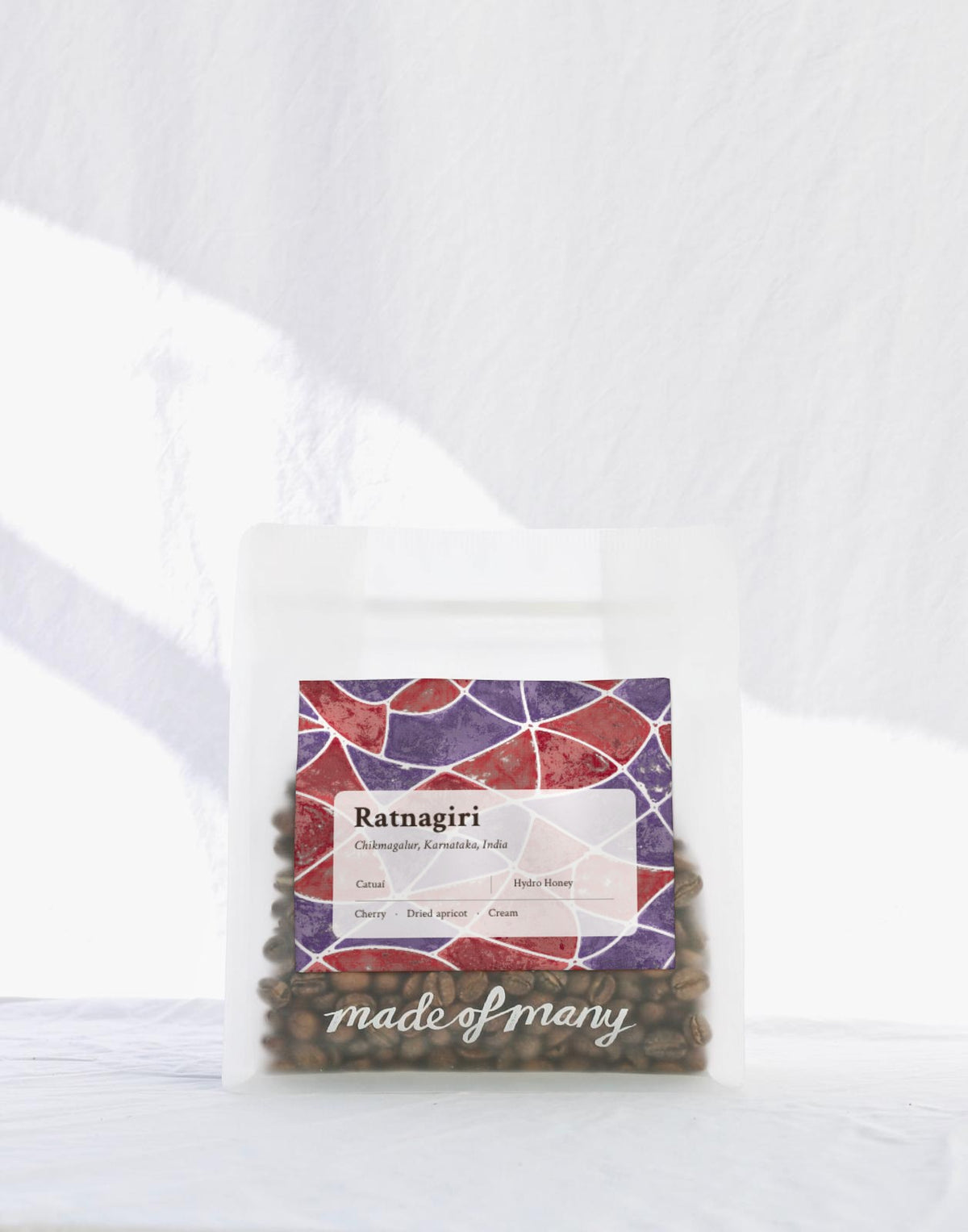
Ratnagiri, India (Hydro Honey)
Ratnagiri, India (Hydro Honey)
Couldn't load pickup availability
*We roast every Tuesday. All orders placed before Monday 11:59pm (AEST) will be roasted and fulfilled that Tuesday. All orders placed after that will be roasted the following week.
Country - India
Region - Chikmagalur, Karnataka
Producer/s - Ashok and Divya Patre, Ratnagiri Estate
Washing Station - On the estate
Processing - Hydro Honey
Varietal/s - Catuaí (selection 8)
Altitude - 1,335 masl
Harvest - Febuary 2026
Flavour Notes - Cherry, dried apricot & cream
This is the second coffee we purchased following our Indian coffee evening at Brighter, and one that really captures what made that night so inspiring. We had the opportunity to explore just how much innovation and curiosity is taking place within India's specialty coffee industry, particularly around processing and the potential of different varieties. There is something really exciting about discovering an origin through the people who are actively exploring what its coffees can become. We couldn't help but bring a little more of that exploration back to Made of Many.
Ratnagiri Estate is located in Chikmagalur, India, and is run by Ashok and Divya Patre. The estate spans 108 hectares, with this particular Catuaí lot grown at 1,335 metres above sea level. What drew us to this coffee was its unusual processing method, known as Hydro Honey. It's a really interesting exploration of how different stages of drying and rehydration can be brought together, rather than following a more traditional natural, washed or honey process.
The process begins by partially drying the whole coffee cherries on shaded raised beds before rehydrating them in water. The cherries are then depulped, leaving most of the mucilage attached to the parchment, and dried slowly on raised beds for a further 33 days. It's essentially a hybrid of natural, washed and honey processing, with each stage carefully arranged to explore a different approach to developing the coffee.
I think what makes this coffee particularly exciting is that it represents the willingness of producers to explore processing beyond the more established methods. We are always curious about how these decisions influence the expression of a variety, and whether they can bring out something unique without losing sight of the coffee itself. It's another wonderful opportunity for us to explore Indian coffee and better understand the work being done by producers like Ashok and Divya.
Espresso Recipe: 1:3 ratio
In: 20 grams dry dose
Out: 60 grams beverage weight output
Time: Contact time of 30 seconds
Filter Recipe: 1:16.5 ratio
In: 20 grams dry coffee
Out: 330 grams brewing water
Time: 2:45-3:00 minutes
Share